
14 Essential Journaling Techniques for Clarity, Growth, and Reflection
When many people imagine journaling techniques, they often picture a teenage girl with a diary of parchment paper and colorful markers. While that creative approach is wonderful, it is not the only way to practice; it is an extremely versatile art with several essential journaling techniques you can use to start a practice for any purpose.
While that certainly is one way to do it, It is not the only one ; it is an extremely versatile art and there are several Journaling Techniques that you can use in your pursuit to start a journaling practice for all purposes. Firstly, you may have the question :
What Is Journaling ?
Journaling is the practice of regularly recording your thoughts, feelings, experiences, and reflections in a personal, private space. It is essentially a conversation with yourself, traditionally committed to paper but more recently done digitally as well.
At its core journaling is a strong tool for introspection. It requires you to pause everything in your life and glance inwards and analyse your mental and emotional state and your feelings within. It also serves as a recording the various stages one goes through in their life and immortalise the triumphs and challenges faced on a daily basis.
It provides a safe outlet for feelings and aids in processing emotions. Most importantly, journaling is unique to each person who attempts it and can look and feel very different to everyone. That being said, there are several kinds of journals and various methods and techniques of how to keep a journal and penning down your thoughts.

The 14 Essential Journaling Techniques
1. Reflective Journaling
- Best for: Clarity, learning from experiences, and steady personal growth.
- Time: 10 minutes.
- How to start: Write one recent event, then what it taught you.
- Try this prompt: “What happened today, and what do I want to take from it?”
Reflective Journalism is the Intentional practice of examining, analysing and finding meaning in your recent experiences, your emotions, your thoughts or anything that you feel the need to reflect on. It lets you process complex emotions and also gives you an insight on how you yourself feel about certain things.
It can be seen as taking ones’ raw experience and turning them into valuable insight. Reflective Journaling can take different forms ; You can write down your observations and your feelings regarding your day to day life. You can describe your emotions and your feelings towards events or situations in your life. You can explore your beliefs and motivations in life and there is so much more you can get from a unique spin on Reflective Journaling.
The core three-step reflective cycle for reflective journaling includes description of the event, Analysing it and then drawing a conclusion. Any kind of reflection works; from small things like your daily behaviours and mannerisms to bigger more major events in your life.
2. Gratitude Journaling
- Best for: Better mood, reduced stress, and noticing what’s going right.
- Time: 5 minutes.
- How to start: List three specific things and why each matters today.
- Try this prompt: “What are three small things I’m grateful for, and why?”
Gratitude Journaling is the simple, intentional practice of regularly documenting the things, big or small, that you are thankful for in life. It helps you reflect on and consider the things you are grateful for in your life. It may be something as small as being able to afford the daily necessities of life or something more major like achieving significant goals in your life.
Its primary focus is to shift your focus from what is lacking , or the negatives, in your life to what is good and abundant in your life. It is a way to savor the positive moments in your life. A gratitude journal doesn’t need to be long ; it is about the depth of the feeling and not the word count. You just have to set aside 5-10 minutes each day and list a few things you are grateful for everyday.
In essence, a gratitude journal is a tool for auditing the good in your life, ensuring that you don’t take your blessings—both big and small—for granted.
3. Stream Of Consciousness Journaling or Free Writing Method
- Best for: Stress relief, mental clarity, and getting unstuck fast.
- Time: 5-7 minutes.
- How to start: Set a timer and write nonstop without editing.
- Try this prompt: “Right now my mind is full of… and I need to say…”
Stream-of-consciousness writing is the practice of writing continuously for a set amount of time or a set number of pages without stopping, editing, or judging the content. This can also be a good entry-point to journaling if you’re not exactly sure of what to write; you just write whatever comes to mind even if it is “I do not know what to write” repeatedly. This is one of the most effective journaling techniques for bypassing your inner critic.
Flow of consciousness is journaling in its purest and rawest form ; a direct transfer of thoughts from your mind to paper. The success of this Journaling Technique depends on one core principle : do not stop writing. The pen must keep moving so that your inner critic does not interrupt which can often lead to surprising insights to surface.
This method of journaling is extremely effective as it bypasses any form of censorship. By prohibiting editing or pausing, it stops the inner critic from filtering your thoughts, often revealing underlying truths or feelings you weren’t consciously aware of. Free writing is the simplest and most accessible form of journaling, requiring nothing more than paper, a pen, and a commitment to let the words flow.

4. Goal Journaling
- Best for: Focus, motivation, and turning plans into daily action.
- Time: 8-10 minutes.
- How to start: Pick one goal and write the next smallest step.
- Try this prompt: “If I moved forward today, what would I do first?”
Goal Journaling is the practice of using your journal to define, break down, track, and ultimately achieve your goals; short-term or long-term. This journaling technique becomes an active companion in your pursuit of achieving all your goals.
It works because it allows you to pen down your goals. Once you’ve actually penned down what your goals are that you want to achieve, you manifest them and work hard towards them. The act of writing your goal down changes it from “just a thought” to a concrete target that you want to work towards and achieve soon. It forces upon you a strategy to build and work out exactly how you’ll work to achieve your goals.
It is a great way to motivate yourself and also hold yourself accountable at the same time.
5. Dot Journaling / Bullet Journaling (BuJo) method
- Best for: Organisation, productivity, and tracking habits without overwhelm.
- Time: 10 minutes.
- How to start: Make three bullets: tasks, notes, and one priority.
- Try this prompt: “What are my three must-dos, and what can wait?”
The Bullet Journaling method—informally the Dot Journal—is a flexible analog system. It is an organisation system that can be customised to suit future planning, task managing, scheduling, and personal journaling all in one notebook.
The BuJo method is based on the idea of intentionality. It forces the user to choose what is truly important by providing a structure to quickly filter and organize tasks and events, preventing them from becoming overwhelmed by long to-do lists. It can comprise of several components which includes but is not limited to future planning, a monthly log and even a daily log depending on your needs. Dot journaling is perfect for the person who needs a system that is both highly structured for productivity and infinitely customisable for personal reflection.
6. Life Timeline Journaling
- Best for: Reflection, self-understanding, and making sense of your story.
- Time: 15 minutes.
- How to start: Draw a line and mark five key life moments.
- Try this prompt: “Which moments shaped me most, and what did they change?”
Life timeline journaling is a one of those journaling techniques where you use your journal to create a visual and written chronology of your life’s most significant moments or achievements. It is essentially a personal biography in visual form, using the structure of a timeline to connect cause and effect across different periods.
Life timeline journaling allows you to gain perspective by clearly identifying recurring life patterns and personal growth over time. This historical context helps to clarify current feelings and decisions, while also providing a solid foundation for planning and projecting future goals and milestones.
It is a powerful, long-view practice that moves beyond daily reflection to offer a panoramic view of your entire existence.
7. Frequency-Based Journaling Techniques
Frequency-based journaling involves setting a rhythm (daily, weekly, monthly, etc.) to match your goals, allowing you to focus on the appropriate level of detail and reflection for that time scale. Choosing the right rhythm is vital when exploring different journaling techniques.
Daily Journaling
- Best for: Consistency, emotional balance, and steady clarity over time.
- Time: 5 minutes.
- How to start: Write three sentences: feeling, highlight, and next step.
- Try this prompt: “How do I feel today, and what do I need most?”
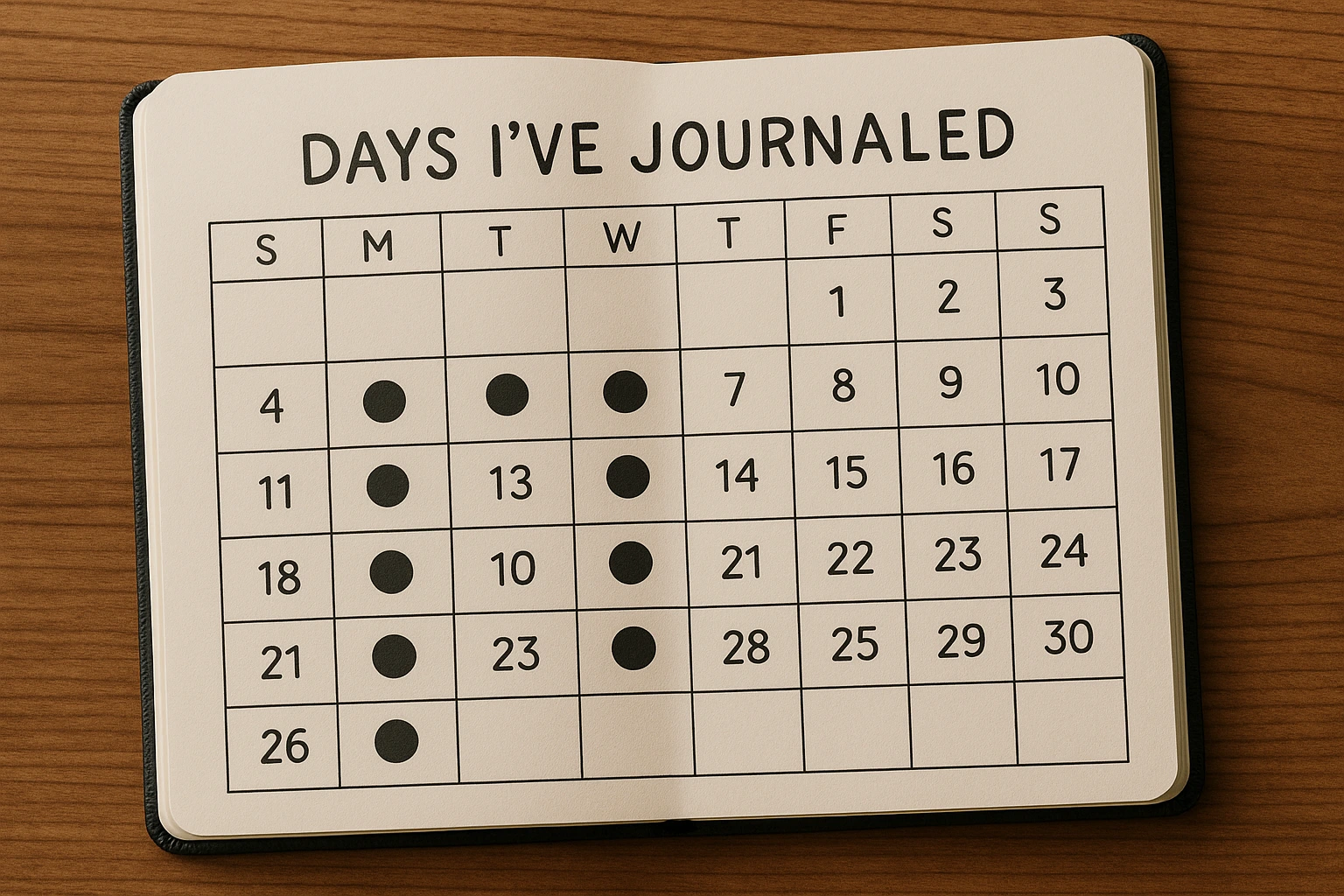
This is the most common and detailed form. It’s focused on immediate awareness and capturing the small moments before they fade. A. daily journal example could include the day to day events and how they made you feel. Over time, a daily journal becomes a log-like record of your life and you can look back at it and pinpoint exactly what you were experiencing in immense detail, which is to be expected since you’re logging it at a daily basis.
Weekly Journaling
- Best for: Big-picture reflection, progress tracking, and resetting priorities.
- Time: 12 minutes.
- How to start: List wins, challenges, lessons, and next week’s focus.
- Try this prompt: “What worked this week, and what should I change next?”
Weekly journaling is a step back from the daily grind. It’s focused on synthesizing information, identifying trends, and planning the next cycle. You may prefer weekly journaling if daily gets too hectic for you. There are several ways to journal on a weekly basis.
You may write down what worked for you and what didn’t in the last 7 days and write down three clear goals for the upcoming 7 day time span. It can include the challenges you have faced, the goals you have accomplished, the lessons you have learnt and how you can improve and build on it in the next week.
Monthly Journaling
- Best for: Goal review, habit check-ins, and long-term growth tracking.
- Time: 20 minutes.
- How to start: Review your month and write three themes you noticed.
- Try this prompt: “What did this month teach me about what I want?”
This level of journaling is highly strategic and goal-oriented. It’s a review of your long-term progress and a chance to course-correct. This may be suitable for reviewing progress on long-term projects, reflecting on the overall quality of the month, and planning major milestones for the next one. It may be most suited to anyone focused on long-term personal or professional goals (e.g., fitness, finances, large creative projects).
As-Needed or Expressive Journaling
- Best for: Processing strong emotions and calming your nervous system.
- Time: 10 minutes.
- How to start: Write what you’re feeling, then why it makes sense.
- Try this prompt: “What am I feeling right now, and what triggered it?”
As-Needed journaling is quite literally what the name suggests it is. It is unstructured and has no fixed time spans between it. You may journal for 3 days in a row and then you might next journal after a couple weeks. It is completely up to you and works towards building a sustainable, pressure-free habit.
8. Creative Journaling
Creative Journaling may well be what we all imagine when we imagine what journaling is; a non-linear artistic approach that uses visual and artistic elements like arts, collage, drawing, paintings, pictures, and more. Journaling doesn’t always have to be written lines on a blank page.
- Best for: Self-expression, mood lifting, and exploring ideas playfully.
- Time: 15-30+ minutes.
- How to start: Add one doodle or collage, then write a few lines.
- Try this prompt: “If my day was a picture, what would it look like?”
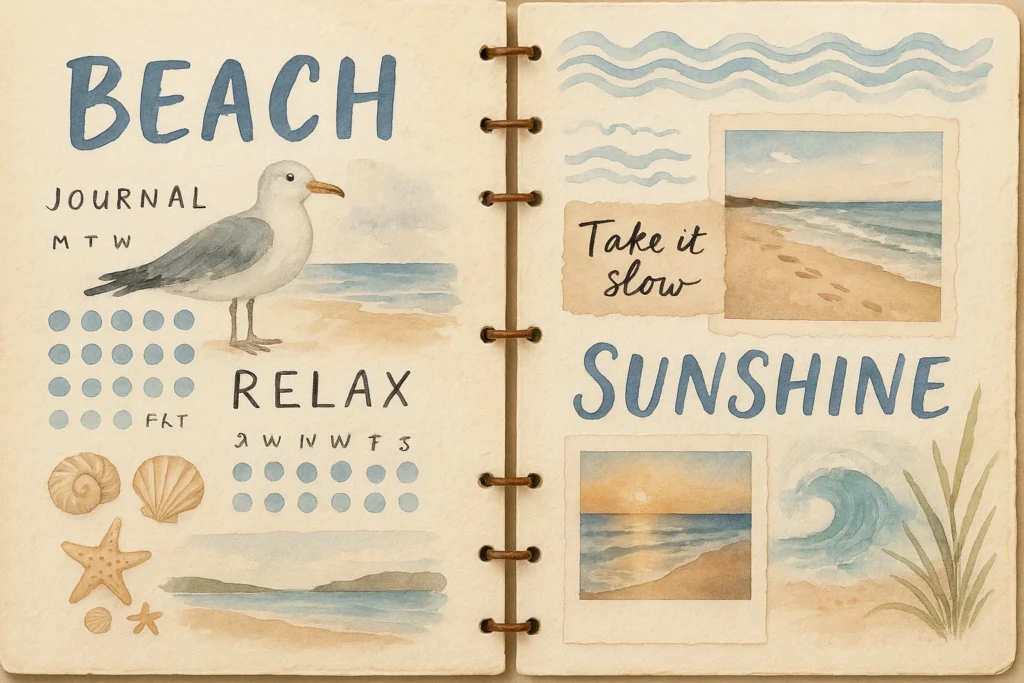
This combines simple writing with other outlets of self-expression like sketching or painting, and is ideal for anyone who feel constrained by simple words or struggle to articulate more complex emotions.
Creative journaling can include types of photo journaling, and video journaling depending on what suits you. The fundamental principle of artistic journaling is that the act of creation is more important than the final result. There is no pressure for the pages to look beautiful or perfect; the journal is a private space for exploration and experimentation.
9. Mind Mapping
- Best for: Brain dumps, problem-solving, and organising messy thoughts quickly.
- Time: 8-10 minutes.
- How to start: Write one topic in the center and branch ideas outward.
- Try this prompt: “What’s on my mind about _, and what connects to it?”
Mind Mapping is a visual and highly effective form of creative and conceptual journaling, distinct from pure writing. It is a powerful way of journaling for organising thoughts, capturing ideas, brainstorming, and structuring information visually. It is based on the idea of imitating the natural, non-linear way the human brain thinks using associations, images, and keywords.
Mind mapping starts with the main topic as a central image. Thick branches radiate out, each representing a primary theme or category. These themes are further broken down into thinner sub-branches and individual keywords. The use of color and images visually organizes the structure and aids memory.
10. One Line A Day Journaling
- Best for: Busy days, memory keeping, and noticing small progress.
- Time: 2 minutes.
- How to start: Write one honest line about today’s main feeling.
- Try this prompt: “Today I want to remember that…”
One Line A Day journaling is a low-commitment method where you limit your journal entries to a single, impactful sentence. This method makes it less of a dreadful task for anyone who struggles with motivation to start; and is a journaling method that drastically lower the barriers to entry.
The goals for this differ from your traditional reflective journaling; the goal isn’t deep reflection or processing but capturing memories and being consistent. Over time, these brief one-line entries create a powerful time capsule, allowing you to look back at and see the condensed essence of your life on any given date.
11. Bible Journaling
- Best for: Scripture reflection, personal meaning, and gentle spiritual focus.
- Time: 10-20 minutes.
- How to start: Choose one verse and write what stands out.
- Try this prompt: “What does this verse show me about my life today?”
Bible journaling is the practice of reading the Bible and recording your personal reflections, interpretations, prayers, and insights inspired by the text. This can be done like annotations in the Bible book itself, or maintain a separate bible journal.
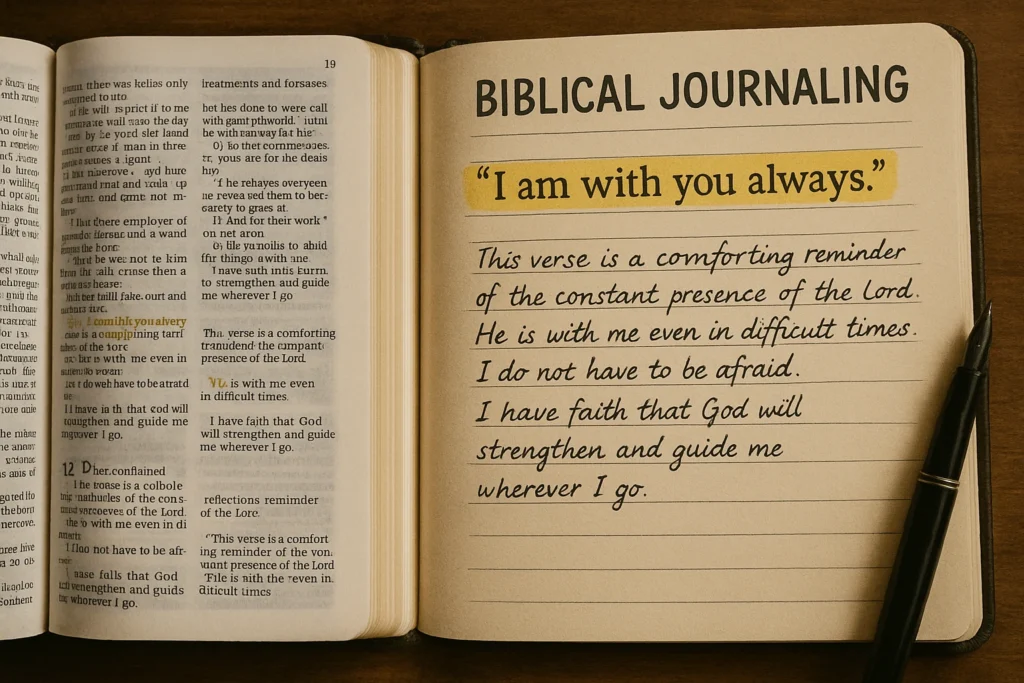
It can be as simple as highlighting or writing down a verse that resonates with you at a personal level and writing down your thoughts regarding it, or it can become the place where you wrestle with difficult passages and write entire paragraphs on how it made you feel, your reservations regarding it and your ultimate conclusions that you draw from it.
A consistent practice of maintaining a biblical journal offers the chance of writing down the verses and ultimately better retaining the verses and committing them to memory. It forces the reader to slow down and clarify complex theological ideas by putting them into their own words. It moves the text from an historical document to a living, relevant guide for personal conduct and faith.
12. Prayer Journaling
- Best for: Calming the mind, gratitude, and focusing your requests clearly.
- Time: 10-20 minutes.
- How to start: Write a short prayer: thanks, help, and hopes.
- Try this prompt: “Today I’m thankful for…, I need help with…, and I ask for…”
A Prayer journal is a closely related yet distinct practice to Bible Journaling. The main distinction lies between the direction of communication; Bible Journaling mainly revolves around receiving instructions from the ancient scripture, whereas the prayer journaling technique is the practice of logging the thoughts and prayers you send instead. It can be thought of letters to a higher, divine power.
Prayer journaling is the practice of committing your prayers, requests, intercessions, and spiritual reflections to writing. It transforms prayer from a fleeting mental activity into a tangible, organized, and trackable record of your ongoing spiritual conversation.
13. Devotion Journaling
- Best for: Daily spiritual routine and applying a teaching to real life.
- Time: 15-20 minutes.
- How to start: Read a short devotion and write one takeaway and action.
- Try this prompt: “What stood out, and how can I live it today?”
Devotional journaling is a spiritual discipline that transforms passive reading into active engagement with your faith. It strengthens your beliefs and equips you for daily living by creating a tangible, focused record of your spiritual journey. It serves as the intersection where Scripture study and communication through prayer come together.
A common method is to use a calendar or blank page for daily entries. After reading your devotion, you select just one or two powerful words, a core phrase, or a key verse that summarizes the lesson learned. This act of selection encourages clarity and intentionality. Many incorporate color, simple doodles, or hand-lettering to reflect and pray over the entry, turning the page into a visually engaging reminder of the day’s spiritual focus.
14. Manifestation Journaling Technique
- Best for: Goal clarity, confidence, and staying aligned with what you want.
- Time: 15 minutes.
- How to start: Describe one desired outcome, then list small steps and evidence.
- Try this prompt: “What do I want, why do I want it, and what will I do today?”
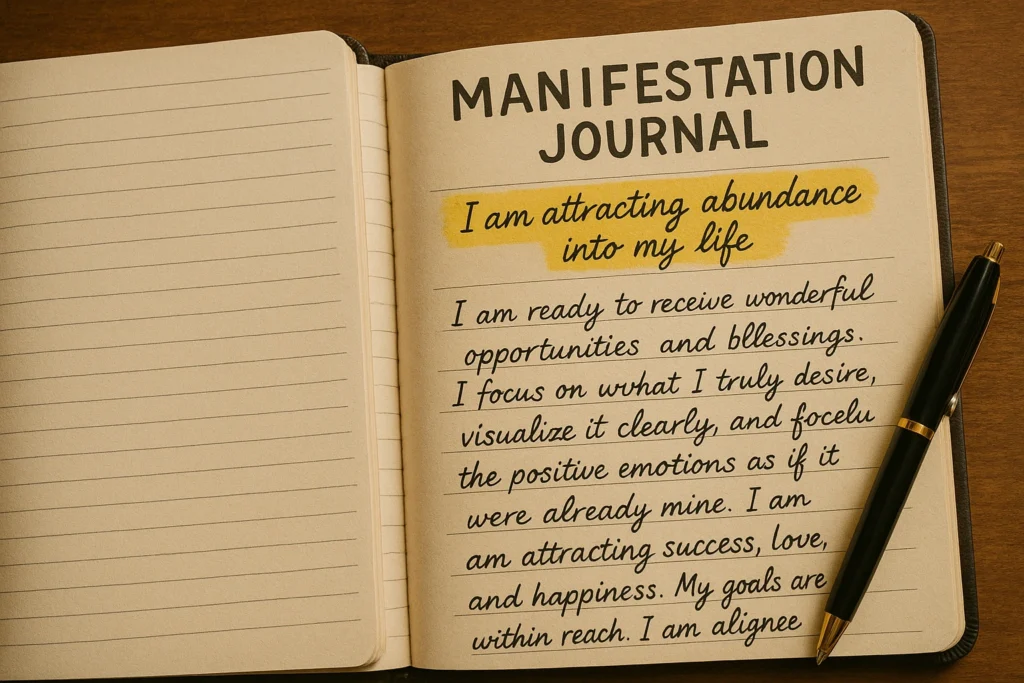
There’s a famous saying that says if you truly want something with all your heart, the entire universe conspires for you to achieve it. A manifestation diary, or a manifestation journal uses the Law Of Attraction ; by focusing your thoughts, feelings, and beliefs on a desired outcome, you can bring it into your reality.
Among all the journaling techniques listed here, manifestation is the most focused on future outcomes. The journal acts as a physical workspace for aligning your subconscious mind with your conscious goals. It shifts your mindset from simply wishing for something to actively believing and behaving as if the desired reality is already true.
The process of consistently writing down your goals and then manifesting them forces you to firstly define your goals concisely and precisely. This then leads to a conscious pursuit of said goals and your brain continues to filter your environment to aid you into achieving your goals. A manifestation journal is ultimately a roadmap for intentional living, using the power of repeated focus to bridge the gap between your current reality and your desired future.
Tips to start journaling
Starting these journaling techniques doesn’t have to be intimidating, or a mountain to climb. The key is to reduce friction and eliminate the mental barriers that stop you before you even begin. Slow and steady wins the race ! Here are some tips that may help you on your merry journal journey :
Define your personal mission, The “Why?”
Review the many journaling types (Gratitude, Goal, Creative, Timeline, etc.) and commit to a single, low-effort method to start.
Start Small, Scale Later: Don’t attempt three pages of reflection when you’re a beginner. Be realistic and start small. Commit to the simplest possible routine, such as the One-Line-A-Day method or the 5-Minute Journal, for the first week. Once that feels easy, you can scale up.
Choose your minimum viable journaling option
Weekly journaling is a step back from the daily grind. It’s focused on synthesising information, identifying trends, and planning the next cycle. You may prefer weekly journaling if daily gets too hectic for you. There are several ways to journal on a weekly basis.
You may write down what worked for you and what didn’t in the last 7 days and write down three clear goals for the upcoming 7 day time span. It can include the challenges you have faced, the goals you have accomplished, the lessons you have learnt and how you can improve and build on it in the next week.
Build your routine according to your needs
Like any habit we take up for our betterment, be it the gym or going on walks and even journaling, the consistency in said activities are built more on structure and less on motivation. We all know how volatile the latter of the two can be. It can be extremely helpful if you anchor journaling to an already existing routine of yours such as before bed or doing it while the kettle boils.
Deciding on a medium and keeping it handy when you know you’ll write your journal is important to reduce friction too. Will you use a digital app (great for speed, searching, and privacy) or the classic pen and paper (better for tactile engagement, flow, and often deeper emotional processing)?
Know that Journaling is a Judgement-Free Environment
The single biggest roadblock for new journalers is the internal pressure to write something profound or grammatically perfect. You must eliminate this self-censorship. Remember, no one else has to see this. Grammar, spelling, and handwriting do not matter. The main purpose of journaling is the benefit it provides in the present moment—emotional release, mental clarity, and reflection.
If you get stuck, use Free Writing rules: just write whatever comes to mind, even if it’s nonsense. Getting the stream flowing is far more important than the content. Use prompts or questions if you struggle to know what to write, but don’t feel obligated to follow them strictly.