
Prayer Journaling for Beginners: How to Start + Ideas, ACTS & SOAP Methods
Prayer journaling is a simple, structured way to slow down and put your prayers into words. If you’ve ever wondered how to start a prayer journal, what to write in a prayer journal, or which prayer journaling methods actually work, this guide will walk you through it step by step.
You’ll find practical prayer journal ideas, beginner-friendly prompts, and clear frameworks like the ACTS prayer method and SOAP method journaling, so you can build a consistent habit without pressure or perfection.
What Is Prayer Journaling?
Prayer journaling can be defined as a reflective writing process. It serves as a means of intentional self-reflection and cognitive organisation. The process involves writing down ideas and worries. The goal is not to find the answer, but to gain clarity.
One of the major aims of prayer journaling is to articulate inner thoughts. If a thought is not expressed externally, it may not be coherent and connected. This is because writing down these ideas allows them to be reviewed in a more detailed manner.
Once recorded, an idea no longer exists solely in the mind, where it can feel absolute or consuming. On the page, it becomes one entry among several pages. What was once overwhelming often turns out to be temporary, recurrent, or incomplete.
Prayer journaling serves as a bridge between thought and awareness, providing a structured space for contemplation. Through this practice, an individual observes recurring patterns, hopes, concerns, and moments of gratitude. Some people also describe this as a faith journal or spiritual journal, especially when entries are written as prayer.
Best for: Clarity, anxiety, reflection, and building a consistent prayer habit.
Time: 5–10 minutes.
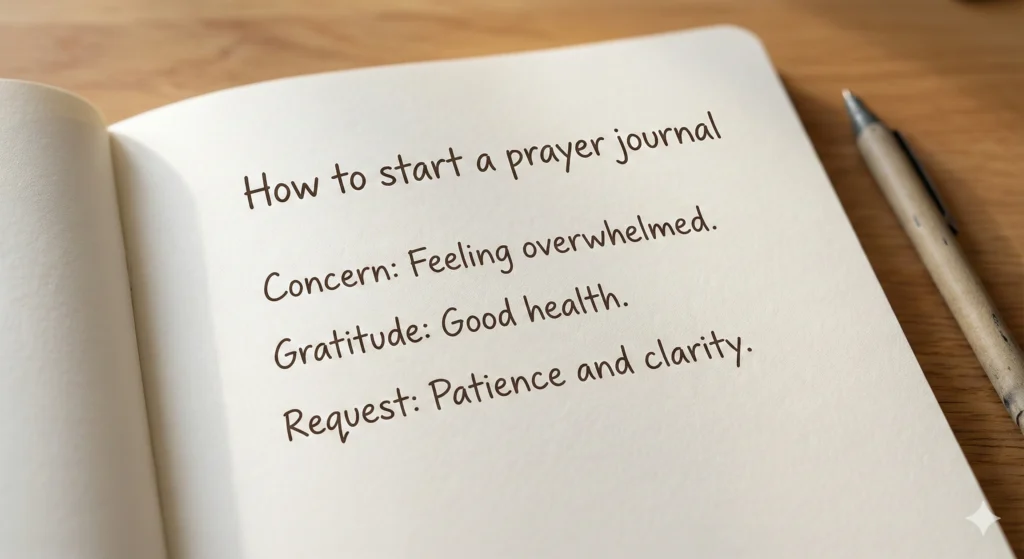
How to start: Write one concern, then one gratitude, then one request.
Try this prompt: “What’s weighing on me, what am I grateful for, and what do I need?”
Read about other journaling techniques here.
Benefits of Prayer Journaling
Prayer journaling supports clarity by giving thoughts a place to sit, rather than staying tangled in the mind. It also helps people notice patterns over time—recurring concerns, recurring gratitude, and changes in perspective. For many, it becomes a gentle spiritual discipline of journaling that supports consistency, especially during anxious or uncertain seasons.
How to Start a Prayer Journal
How It Works
It is easy to journal your prayers, but one must write with intent, regularly, attentively, and without the pressure to reach conclusions. It does not involve fancy writing skills but relies upon regularity and truthfulness. By putting down one’s thoughts on paper, the writer offers them distance with the aim of reflection as opposed to immediate reaction.
It usually begins with a focus that can be identified from a concern, question, decision, or just feeling uneasy about what’s going on. In fact, gaps come to light only when we write our thoughts down in words. Once the thoughts unravel on paper, emotions so inconspicuous that normally you wouldn’t realize they were there at all suddenly stand out, even if just for an instant. Repeated, our introspection deepens into patterns of awareness, changes in perception, moments of insight we might otherwise miss.
Beginner Steps (Simple and Repeatable)
For those new to this practice, keeping a prayer journal can feel unfamiliar or even daunting. It can be structured into different frameworks that best suit the writer’s preferences and goals. Beginners are advised to start small, understanding that the writing process itself is the practice, not the content of each entry.
None of these frameworks are rigid systems; rather, they are organizing tools to help beginners get started. While there is continuity in each method, each one offers a unique manner to engage thoughts, values, and concerns.
What to Write in a Prayer Journal
When you don’t know what to write in a prayer journal, start with what feels most present. A simple entry can include:
- A concern, question, decision, or situation that feels unresolved
- What you are experiencing emotionally or mentally right now
- One gratitude (even a small one)
- One clear request for help, guidance, strength, patience, or clarity
- A short follow-up line later (what changed, what stayed the same)
Prayer Journal Ideas
Letters to God Journaling
Another style of journaling is the letter style, usually referred to as letters to God journaling, writing letters to a higher presence, to life itself, or to an abstract source of meaning. The value of this method is basically the conversational structure.
Speaking thoughts out loud makes one more honest and less self-censoring. The format allows individuals to express uncertainty, frustration, or hope without requiring resolution. Even if the recipient is symbolic, writing as if they were listening to you improves emotional clarity and consistency.
Prayer Mapping
Prayer Mapping is more visual and analytic, placing thoughts spatially, often around a central concern, with related ideas, emotions, and influences branching outward. This technique is helpful in complex situations where many factors may be operating, such as decision-making or ongoing stressors. Mapping reveals the relationship of thought to thought and points to areas that need further reflection.
Morning Prayer Journal Prompts (Simple and Practical)
Morning entries work best when they are short and grounded. A simple morning prayer journal page can include: what matters today, what you need help with, what you want to release, and one thing you are grateful for before you start.
Freeform and Thematic Prayer Journal Ideas
Other structures could involve freeform reflection, which is writing without structure and letting thoughts, emotions, and desires flow naturally onto the page. Thematic journaling that focuses on topics like forgiveness, thankfulness, or personal development may promote complex understanding. By providing direction, these frameworks could lead to regular reflection.
Methods & Frameworks
ACTS Prayer Method (Adoration, Confession, Thanksgiving, Supplication)
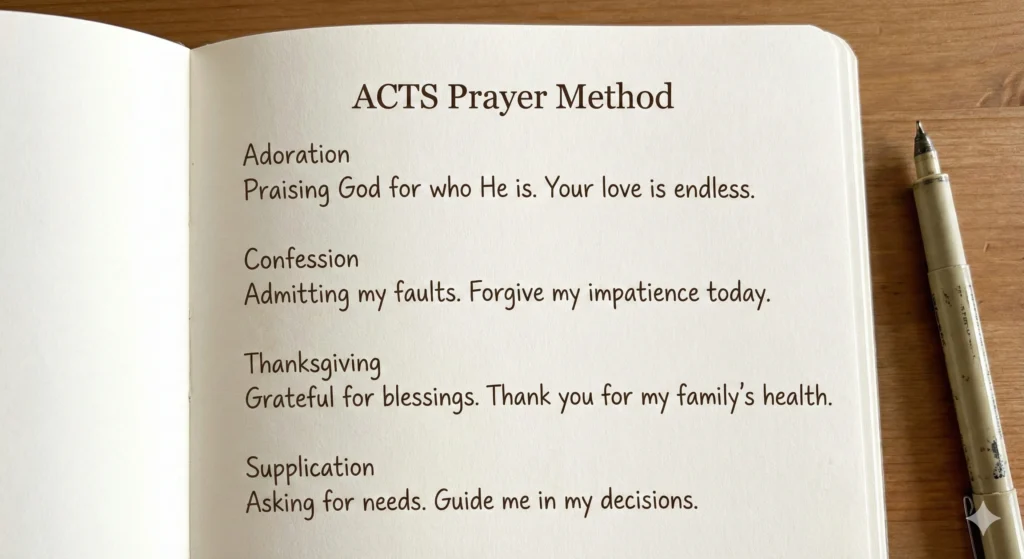
The ACTS prayer method is one commonly applied structure. Adoration involves recognizing and expressing reverence, praise, or focus toward God. Confession focuses on naming personal limitations, mistakes, or areas of internal conflict.
Thanksgiving directs attention to experiences or conditions that are currently supportive or beneficial. Supplication involves articulating needs, intentions, or directions for growth. Used in such a manner, the ACTS method serves as a well-rounded examination of internal and external factors influencing the individual.
SOAP Method Journaling (Scripture, Observation, Application, Prayer)
SOAP method journaling is a simple form of scripture-based prayer journaling that keeps the entry focused and practical. It moves from a short Scripture to a clear observation, a personal application, and then a written prayer.
Mini template (SOAP):
- Scripture: Write one verse or short passage.
- Observation: What stands out, and why?
- Application: What does this change or invite today?
- Prayer: Write a short prayer response.
Intercessory Prayer Journal
An intercessory prayer journal focuses on praying and writing for others with clarity and consistency. Keep it simple: write a name, a specific need, and a short follow-up note on what changed over time. This format also supports journaling for answered prayers without forcing conclusions.
Prayer List Strategy
A prayer list strategy helps you avoid repeating vague entries while still staying consistent. Keep a short active list (current needs), a long-term list (ongoing concerns), and a gratitude list (what is supporting you). Review briefly, then write one focused entry.
War Room Prayer Journal (Simple Setup)
A war room prayer journal is a focused approach where you keep prayer requests organized in one dedicated space. You can group entries by category (family, health, work, decisions), date them, and add brief follow-ups over time. This approach supports consistency and makes it easier to track personal growth through prayer without needing long entries.
Templates for Common Prayer Journaling Frameworks
The following templates are designed to provide structure without prescribing belief. They can be used as written, adapted, or simplified depending on individual needs. The goal of each template is to support clarity, consistency, and focused reflection.
ACTS Prayer Method (Adoration, Confession, Thanksgiving, Supplication)
The ACTS prayer method is one commonly applied structure. Adoration involves recognizing and expressing reverence, praise, or focus toward God. Confession focuses on naming personal limitations, mistakes, or areas of internal conflict.
Thanksgiving directs attention to experiences or conditions that are currently supportive or beneficial. Supplication involves articulating needs, intentions, or directions for growth. Used in such a manner, the ACTS method serves as a well-rounded examination of internal and external factors influencing the individual.
SOAP Method Journaling (Scripture, Observation, Application, Prayer)
SOAP method journaling is a simple form of scripture-based prayer journaling that keeps the entry focused and practical. It moves from a short Scripture to a clear observation, a personal application, and then a written prayer.
Mini template (SOAP):
- Scripture: Write one verse or short passage.
- Observation: What stands out, and why?
- Application: What does this change or invite today?
- Prayer: Write a short prayer response.
Intercessory Prayer Journal
An intercessory prayer journal focuses on praying and writing for others with clarity and consistency. Keep it simple: write a name, a specific need, and a short follow-up note on what changed over time. This format also supports journaling for answered prayers without forcing conclusions.
Prayer List Strategy
A prayer list strategy helps you avoid repeating vague entries while still staying consistent. Keep a short active list (current needs), a long-term list (ongoing concerns), and a gratitude list (what is supporting you). Review briefly, then write one focused entry.
War Room Prayer Journal (Simple Setup)
A war room prayer journal is a focused approach where you keep prayer requests organized in one dedicated space. You can group entries by category (family, health, work, decisions), date them, and add brief follow-ups over time. This approach supports consistency and makes it easier to track personal growth through prayer without needing long entries.
Templates for Common Prayer Journaling Frameworks
The following templates are designed to provide structure without prescribing belief. They can be used as written, adapted, or simplified depending on individual needs. The goal of each template is to support clarity, consistency, and focused reflection.
ACTS-Based Reflective Template
This template follows a balanced sequence that encourages perspective before problem-solving.
Adoration
- What do I want to praise or honour about God today?
- What aspect of God’s character do I want to focus on right now?
Confession
- What am I struggling with right now?
- Where might I be avoiding responsibility, clarity, or honesty?
- What assumptions or reactions should I examine more closely?
Thanksgiving
- What is working, supporting me, or sustaining me at present?
- What recent experiences, resources, or people have been helpful?
Supplication
- What guidance do I need moving forward?
- What qualities or outcomes am I aiming to develop (e.g., patience, focus, balance)?
- What direction feels most aligned with my values right now?
Letter-Style Journaling Template
This format uses direct address to encourage openness and continuity of thought.
Opening
- “Today, I want to reflect on…”
- “I am writing about something that has been occupying my attention…”
Main Body
- What am I experiencing emotionally or mentally right now?
- What feels unresolved, confusing, or pressing?
- What questions am I holding rather than answering?
Reflection
- What do I understand more clearly after writing this?
- What remains uncertain, and why might that be acceptable for now?
Closing
- What intention, request, or commitment do I want to name before ending this entry?
Prayer Mapping Template
This method emphasises structure and relationships between ideas rather than linear writing.
Center (Primary Focus)
- Write the main concern, question, or situation in the center of the page.
First Layer (Key Factors)
- What thoughts, emotions, or external factors directly relate to this issue?
- Who or what is involved?
Second Layer (Deeper Reflection)
- What fears, values, or expectations are influencing my response?
- What past experiences may be shaping how I see this situation?
Outcome Area
- What clarity am I seeking?
- What possible next steps or attitudes feel reasonable?
Open-Ended Prompt Template
Useful for days when focus feels diffuse or motivation is low.
- What moments today felt significant, even in small ways?
- Which events or interactions drew your attention or emotion most?
- Which situations feel unresolved or difficult to face?
- How have you responded to challenges recently, and what might you learn from those responses?
- What are the three things you are grateful for today?
- What small, often unnoticed details brought you a sense of peace or joy?
- What do I hope for in my life, for myself or for others?
- Are there areas where I seek guidance, clarity, or strength?