
Reflective Journaling Prompts: How to Start a Reflective Journal for Self-Discovery
What Is Reflective Journaling
The hardest part of growth isn’t learning something new but remembering what we already know.
There are moments of crystal-clear insight, the kind where everything clicks. You understand why you react the way you do, why a pattern keeps repeating, why something hurts. In those moments, change feels inevitable. Almost easy. Then life happens and a few days later, you’re right back where you started, wondering how that clarity slipped so easily. That’s where reflective journaling comes in.
Reflective journaling prompts help you move beyond “what happened” and into “what this revealed about me.” Reflective journaling isn’t just writing about what happened in your day. It’s about you in the day. Your emotions. Your thoughts. Your reactions. The quiet assumptions you didn’t realize you were making. It’s less about “what I did” and more “this is what this experience revealed about me.”
At its core, reflective journaling is a pause. A deliberate moment where you slow down enough to notice what’s going on inside you. It asks you to step out of autopilot and look at your experiences with curiosity instead of judgment. Over time, this understanding builds emotional maturity, self-compassion, and intentional living. Growth stops being accidental and starts becoming conscious.
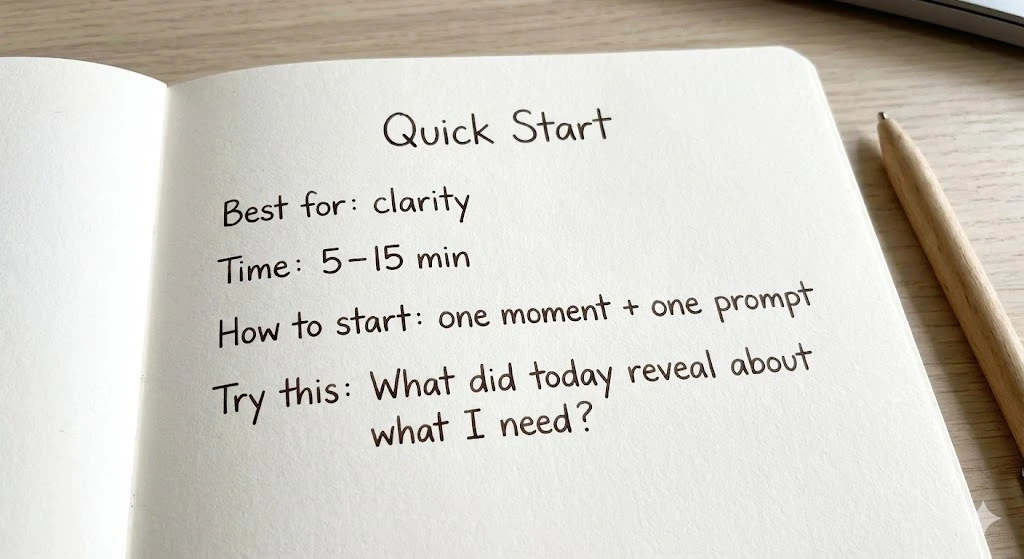
Best for: self-awareness, journaling to process emotions, clearer decisions.
Time: 5–15 minutes.
How to start: pick one moment from today and use one prompt.
Try this prompt: “What did today reveal about what I need right now?”
Read about other journaling techniques here.
Stages of Reflection
Reflection isn’t a single thought or realization; it’s a process that unfolds in stages.
First, there is experience—something happens. A conversation, a mistake, a success, a moment that lingers. Then comes awareness—noticing that the experience affected you. An emotion surfaces. A discomfort. A sense of pride or resistance.
Next is reflection, asking why it mattered, what it triggered, and what it reveals about you. This is where understanding deepens. Finally, there is action—using what you’ve learned to guide future choices. Even if no immediate change is made, the insight stays with you.
Why Is Reflective Journaling Important
Life can feel like a boat drifting in a foggy sea. You know you want to go somewhere, but you’re not sure which way to row. Journaling is like checking the compass: you jot down your thoughts, your feelings, your wins and mistakes, and suddenly the direction becomes clearer.
When everything stays in your head, it’s easy to minimize, rationalise, or forget. On paper, there’s nowhere for denial to hide. You start noticing things like:
- I always feel anxious after talking to this person.
- I’m most calm when my mornings are slow.
- I’m harsh with myself when I make small mistakes.
- I feel proud when I follow through, even on tiny promises.
Reflection can lead to realizations that trigger motivation to act. Start writing after a rough week at work, and reading back your notes can make you notice the real setbacks of your week. That awareness can change how you approach the next week with more clarity instead of ignoring the signs that something needs to change.
How to Start Reflective Journaling
So how do you actually do it? Starting is often the hardest part, mostly because we think it needs to look a certain way. It doesn’t. You don’t need perfect grammar, deep wisdom, or a quiet hour. Start small. Smaller than you think you need to.
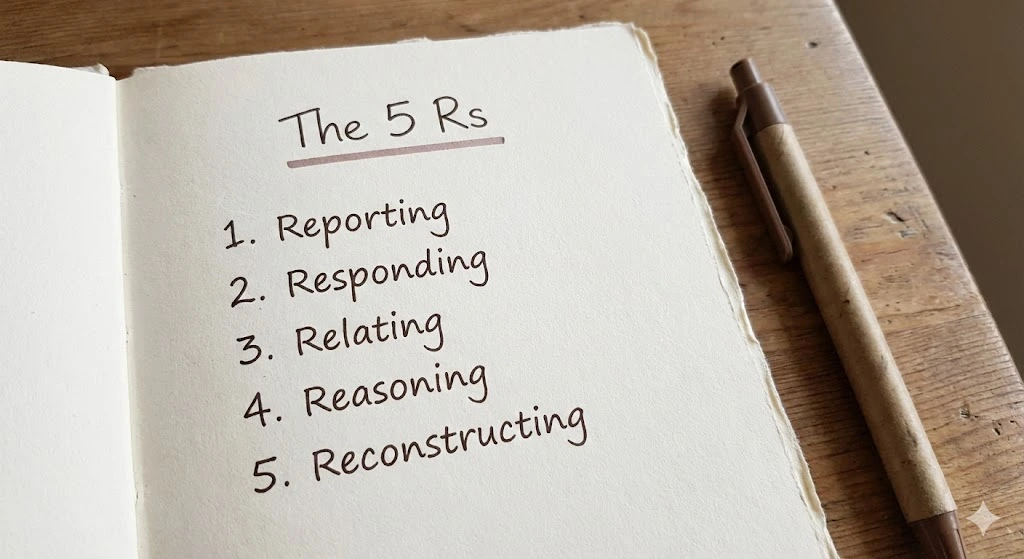
The 5 Rs of reflective journaling are a simple framework to help you move from experience to insight to growth. Think of them as gentle steps, not rules. You don’t have to hit all five perfectly every time.
1) Reporting (what happened)
Reporting focuses on facts. This step grounds you in reality. Begin with what’s present.
- What happened today that stayed with me?
- What did I avoid?
2) Responding (how you felt)
Responding explores emotions.
- What was my reaction?
- Why do I think I reacted that way?
This is where honesty starts.
3) Relating (patterns and meaning)
Relating connects the experience to your past, values, or patterns.
- Have I felt this before?
- Does this remind me of something?
- Is this reaction familiar?
Here, personal meaning emerges. This is also part of the reflective writing process: noticing the thread, not just the moment.
4) Reasoning (insight)
Reasoning looks for insight.
- Why did this happen the way it did?
- What does it teach me about myself?
This is where growth takes shape.
5) Reconstructing (what you’ll do next)
Reconstructing focuses on the future.
- What do I want to do differently next time?
- What would be a kinder response to me here?
This is reflective journaling for personal growth in its simplest form.
Reflective Journaling Prompts Library
If you still feel stuck, prompts help. Below is a prompt library you can return to anytime. Use one question, write honestly, then stop. Consistency matters more than length.
If you’re specifically looking for journal prompts for self discovery, start with the first section below and keep your answer short.
Self-discovery prompts
- What did I learn about myself today?
- Did I act in line with my values?
- What pattern keeps showing up in my life right now?
- What am I avoiding, and what is it protecting me from?
- What do I wish I had handled differently?
- What part of today felt most like “me”?
- What am I proud of that I’m tempted to minimize?
- What do I need more of in my life right now?
- What do I keep trying to prove, and to whom?
- What belief about myself is being challenged lately?
Mindfulness journal prompts
- What am I feeling right now, in my body?
- What emotion keeps trying to get my attention?
- What thoughts did I repeat most today?
- What felt uncomfortable, and where did I feel it?
- When did I feel most calm today, and why?
- What moment did I rush through that I could slow down next time?
- What is one thing I can accept today without fixing it?
- What did I need today that I didn’t name?
- What did I resist today?
- What would “curiosity instead of judgment” look like right now?
Daily reflection questions / end of day reflection prompts
- What went well today and why?
- What challenges or frustrations did I face?
- How did I feel, and why?
- What drained me today?
- What gave me energy today?
- What did I avoid, and what did it cost me?
- What conversation stayed with me the most?
- What did today reveal about what I need?
- What did I learn from today, even if it was small?
- What could I do differently next time?
Positive journal prompts
- What am I grateful for today?
- What did I do well today, even if it was small?
- What did I handle better than I would have in the past?
- Where did I show courage today?
- What’s one thing I want to remember from today?
- What was a quiet win I almost ignored?
- What quality in myself am I noticing more lately?
- What relationship or moment felt steady and good?
- What is improving, even slowly?
- What am I learning to trust?
Journal prompts for self care
- What does rest look like for me right now?
- What boundary do I need to reinforce?
- What am I carrying that isn’t mine to carry?
- What would it look like to be kinder to myself today?
- What do I need to forgive myself for?
- What would support look like this week (practically)?
- What habit is quietly harming me?
- What is one small promise I can keep to myself tomorrow?
- What do I need to stop normalizing?
- What would “enough” look like today?
Deep reflection questions for adults
- What pain am I still negotiating with?
- What am I afraid will happen if I change?
- What story do I keep telling myself, and is it true?
- What do I crave most right now: comfort, approval, control, or peace?
- What do I keep chasing that never actually satisfies me?
- What would I do if I trusted myself more?
- What emotion do I avoid the most, and why?
- What would it look like to live more intentionally this year?
- What am I not saying that needs to be said (to myself or someone else)?
- What does “a meaningful life” look like for me, realistically?
What to Write in a Reflection Journal (If You Feel Stuck)
If you’re not sure what to write in a reflection journal, make it concrete. Pick one of these and write 5–10 lines.
- A moment that lingered: one conversation, comment, or scene you keep replaying.
- A strong reaction: what triggered it, what you felt, and what you needed.
- A repeating pattern: where it shows up, how you respond, what it costs you.
- A choice you’re avoiding: what you’re afraid of, and what you actually want.
- A boundary check: where you felt resentment, and what it’s pointing to.
- A small win: what it says about the kind of person you’re becoming.
This kind of journaling to process emotions isn’t about getting it “right.” It’s about getting it down clearly enough to see.
Using Reflective Journaling in Everyday Life
Reflective journaling isn’t to be saved only for big emotional moments. It’s most powerful when used regularly in ordinary life. You can reflect on small frustrations, daily habits, conversations, or recurring moods. Over time, these entries reveal patterns that are impossible to see in your head alone.
You may not always be ready to change what you notice. That’s okay. Awareness alone is powerful. It keeps you from drifting too far without realizing it. It helps you notice when something no longer fits: a habit, a relationship, a way of speaking to yourself.
Reading your entries back is just as important as writing them. Recording momentary dissatisfaction with a behavior and committing to read it later means delusion can only survive for so long. When you revisit what you wrote a week or a month ago, you see your life as a story instead of a blur. Themes repeat. Growth becomes visible—and so does stagnation.
Common Difficulties and Fear of Honesty
One of the biggest challenges in reflective journaling is resistance. Sometimes we avoid writing because we’re tired. Sometimes because we’re afraid of what might come up. True reflection requires honesty, and honesty can feel uncomfortable.
There’s a fear of judgment even from ourselves. A fear that writing something down will make it too real. A fear of admitting patterns we’re not ready to change. It’s easy to confuse reflection with overthinking.
Overthinking is like running the same track in your mind repeatedly, never reaching a finish line. Reflection, on the other hand, is pausing on that track, looking at the scenery, noticing the bumps, and deciding where to step next. One traps you in worry; the other guides you toward understanding and growth.
The goal isn’t to criticize yourself or force growth before you’re ready. It’s witnessing yourself with compassion. You’re allowed to write “I don’t know.” You’re allowed to feel confused, angry, or stuck. Honesty doesn’t demand perfection. It only asks for presence.
Conclusion
Reflective journaling is not about fixing yourself. It’s about understanding yourself. Through reflection, we learn to slow down, listen inwardly, and notice what our experiences are trying to teach us. Over time, this practice builds clarity, emotional resilience, and intentional living.
Growth doesn’t come from dramatic change. It comes from repeated moments of awareness. When we reflect, we stop running from ourselves and meet ourselves deeply.